
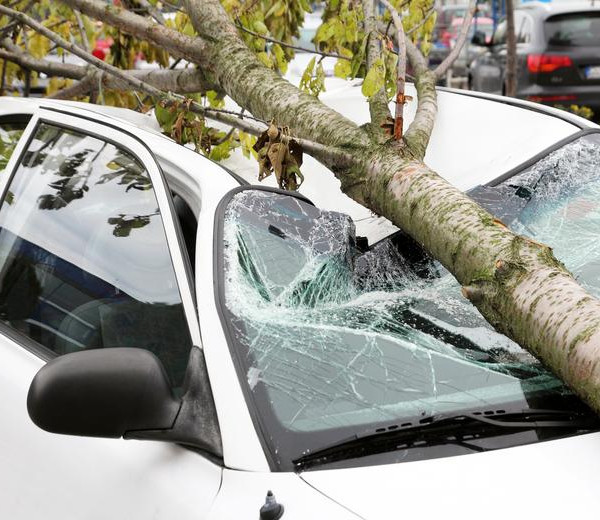
As the winter weather storms continue to batter the east coast, it becomes increasingly likely that property damage will occur. This often results in one neighbor’s property damaging another, which can lead to tense neighborhood encounters as well as steep financial costs. Often the question arises of who is responsible for the property damage inflicted when it involves more than one party.
Here’s a look at one sample case that may provide insight into a situation you are currently working through.
The Situation: In this particular incident, a driver left his car parked on the side of a street which had metered parking. He paid the parking fee, and went about his daily business. When he returned to the car, he was alarmed to discover that a falling tree branch had hit his car and completely shattered the windshield, as well as dented the roof of the car. One of the complicating factors in this case is that the trees were private property, and belonged to a commercial management company.
This individual wrote and asked what the impact would be on their insurance company if they were to file a comprehensive claim, hoping that it would not negatively affect their deductible or cause a rate increase. The damage was in the thousands. Further complicating the case was the fact that while the trees were the property of the private company, the road on which the car was parked was property of the County.
The questioner’s hopes were that the company could be found liable for not trimming their trees, since it was because of the tree’s presence that his car was damaged to begin with. Clients such as these often look for precedent or other recourse in attempting to solve this situation as quickly as possible.
Our Response: In a case such as this one, filing a comprehensive claim will usually not have a negative impact on insurance rates, unlike a collision claim which usually does. The windshield might be covered without deductible, and the cost associated with fixing the roof will vary depending on the amount of damage and the overall vehicle itself.
Additionally, after making a claim your insurance provider should go after the owner of the property from which the tree fell to make full financial restitution. If that cannot be done, you’ll be paid by the insurance company. Your deductible will be taken initially, but returned in the event that they are successful in collecting the penalties from the owner of the property that the tree fell from.
As in all cases, it is important to confer with us to ensure that you fully understand all of the details of your claim and how it will have an effect on your specific policy. For more information about the multitude of services that we provide here at Berliner-Gelfand, contact us today at 203-367-7704. We look forward to serving you and providing a full consultation about your specific insurance claims and cases.